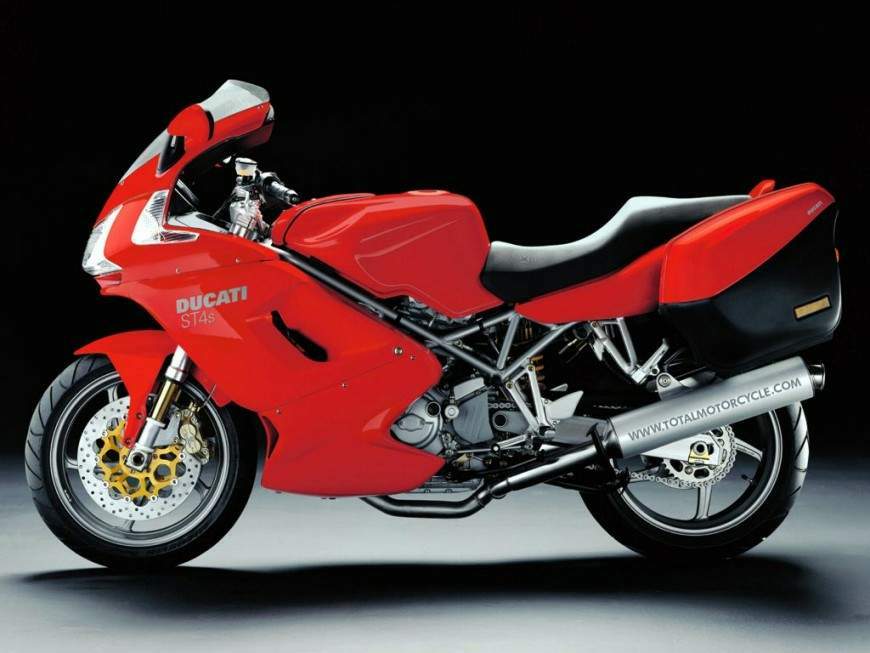
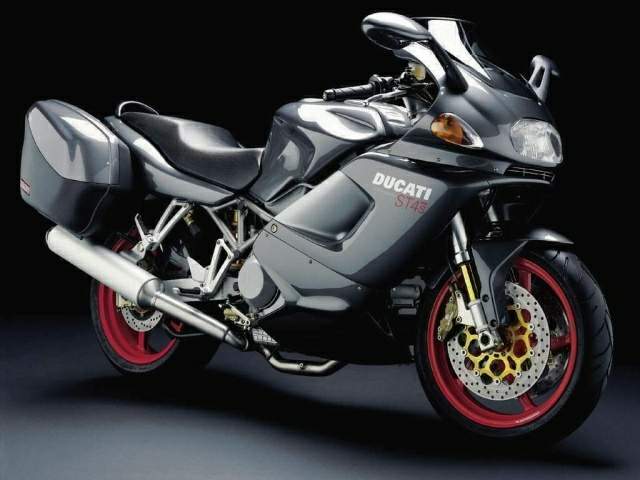
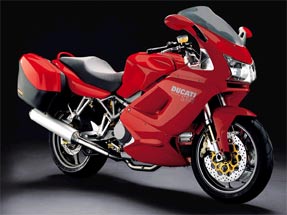
2006 Ducati ST3
The ST3 sports a powerful, 3-valve, Desmo L-twin engine. Matched with its Superbike-derived trellis frame, adjustable suspension, comfortable two-up riding position and optional colour-matched luggage, the ST3 is at ease on both twisty mountain roads and cross-country motorways.
Intelligently designed with high quality components throughout, the ST3 is a powerful and extremely versatile bike never short on muscle. It is the ideal choice for all touring adventures.
Improved reliability and low emissions make the ST3 a confident choice to tackle wild mountain passes and endless stretches of highway. Producing 107 HP at 8750 rpm, the ST3 has more than enough power for the long haul and inspires confidence, even when two-up and under the full weight of luggage.
Extend the versatility and comfort of your ST with our most popular Sport Touring accessories – colour matched saddlebags are INCLUDED with all U.S. market ST3s. Top cases and other accessories are available for the entire ST family. They will protect your gear from the weather and allow you to comfortably leave most full-face helmets in a safe place.
MSRP $11,995 USD
Features:
DUCATI SPORT TOURING
In response to massive public demand the three-valve per cylinder engine takes centre stage in the ST range for the 2006 M.Y. The standard version is thus joined by the ST3s ABS, in place of the previous ST4s, the flagship of this family up to the end of last season.
This means that the price list is simplified, with two versions offering the original equipment package plus a series of major innovations.
The 2006 model is equipped with a new automatic idle speed control system and, above all, features Euro 3 homologation in compliance with future emission control regulations. This major breakthrough, which anticipates the date of enforcement of the more stringent emission limits by more than twelve months, was achieved by adopting an integrated ignition, injection and exhaust system, with a special 3-way catalytic converter and heated Lambda oxygen sensor. Thanks to this design strategy, the ST3 and ST3s ABS machines scheduled to roll of the lines at the Ducati Borgo Panigale plant will be among the world's first bikes to comply with the emission limits due to take effect on 1 January 2007, so they can be ridden even in cities that restrict non-complying vehicles.
The evolution of the injection and ignition system, combined with automatic idle speed control, are among the most recent milestones in a continuous process of updating a range of machines specifically designed for touring enthusiasts seeking comfort and a high level of protection from the elements without sacrificing performance muscle. The earlier editions had already received various modifications designed to meet the more practical needs of a Sport Touring machine. For example, the wet clutch, which is smoother, quieter and more progressive than the unit installed on more highly tuned Ducati motorcycles while also offering much longer than average service life; in addition, a large number of updates have been made to the machine with the aim of optimising the level of protection and, consequently, the overall comfort on long high-speed journeys.
Evolved and further refined with each new edition, the Sport Touring range achieves perfect balance with the arrival of the three-valve per cylinder engine, as demonstrated by the fact that this twin cylinder powerplant won immediate approval from the market thanks to its broad flat torque curve and low fuel consumption.
The state of the art achieved since 1997 when the first ST was unveiled is such that Ducati has been able to attain a position of excellence in a segment in which rival motorcycle makers can boast many years more experience than the Bologna company. The current high standing on the touring market is largely due to Ducati's reinterpretation of the sports touring motorcycle and the implementation of a number of innovative devices. Consider, for example, the many adjustment facilities on the machine including the position of the handlebars, electronic control of the headlight beam angle and two alternative positions for the exhaust system. The two tailpipes can be mounted in a low-slung position so that the machine can be equipped with a pair of panniers, or in a raised position to increase the lean angle for riders seeking extreme lean angles. There are also many apparently minor aspects, such as the simplified fitting system for the fairings, which reduces times and costs for servicing and repair work, and management of the electronic system with a CAN line, with the network carried on just two wires in place of the classic harness.
ST3
The ST3 is the ideal solution for demanding tourism riders who instead of being contented with the classic "German style" of touring, insist on the typical verve of an Italian machine. In addition to the high level of protection, the careful attention devoted to ergonomics and the sophisticated chassis, riders can rely on an engine that has been specifically designed to reconcile several extremely divergent riding characteristics. The adoption of desmodromic timing with three valves per cylinder and dual spark ignition has made it possible to obtain the power needed to achieve an impressive level of performance while simultaneously keeping a tight check on fuel consumption. And these benefits are obtained in an environmentally friendly manner, as evident by the Euro3 homologation, which was gained well before the deadlines envisaged by the standards.
Style
The design of the ST Ducati strove to reconcile various contrasting aspects, one of which was related to the management of overall dimensions. In this context, it was important to offer the necessary protection for the rider and passenger, while simultaneously maintaining a slender profile of the machine to avoid negative effects on agility and a reduction of the sports capabilities of this model. The solution was arrived at with a carefully calibrated blend of elegant lines and functional features designed to meet aerodynamic requirements. The ST3 is therefore the perfect long-distance machine for all the typical touring situations, while still being suitable for other types of use, from busy city streets to the race circuit.
Chassis
The ST3 was born to travel, but a pure Ducati heart throbs just under the skin, and the design project was conducted with a constant eye on the sports aspect. Consequently one of the defining aspects of Ducati's DNA has been retained in the form of the high strength tubular steel trellis frame present in all the families, including the Desmosedici of MotoGP world championship fame. The steel trellis frame is a technological aspect in which Ducati has acquired an enviable level of experience that makes it possible to obtain a fitting response for all riding styles. Among the acknowledged benefits of this solution it's worth recalling the reduced weight and high level of stiffness, both of which characteristics bring clear benefits to both solo riding at high speed and long trips with a passenger and a full load of luggage. Of course, the Ducati Sport Touring machine makes it easy to find the perfect setup for all types of trips thanks to the use of highly versatile front and rear suspensions. The front end is equipped with a Showa fork with adjustable preload, while the rear of the bike is mounted on a Sachs monoshock with full preload and hydraulic damping adjustments.
Powerplant
Almost two years ago a new family of engines was launched to join the universally acclaimed Desmodue and Desmoquattro: the Desmotre. This powerplant is the product of the very latest engineering techniques and offers an intermediate solution between the classic air-cooled two-valves per cylinder twins and the more sports oriented four-valve engines. With its three valves per cylinder the new engine lies at the mid point in terms of cylinder head valve arrangement, although it manages to condense the qualities of the other engines in relation to the low fuel consumption and flexibility of the simpler versions and the power output of the more sophisticated models. Right from the time of its launch the Desmotre had all the necessary credentials for Euro2 homologation and today, with the 2006 model, the ST3 is one of the first production machines to offer even lower exhaust emission levels. This goal was achieved thanks to the adoption of an integrated ignition, injection and exhaust system with a special three-way catalytic converter and heated Lambda oxygen sensor. Another important breakthrough is constituted by the addition of automatic idle speed control provided by a stepper motor, which consequently eliminates the need for manual activation of the choke lever. The benefits of the three-valve cylinder head, which features desmodromic control in compliance with Ducati tradition, include plenty of torque at low engine speeds and fuel consumption that is among the lowest in the category (typical of 2-valve engines) combined with high power throughout the engine speed range (typical of 4-valve engines). In this context it should be noted that numerous components were designed specifically with the aim of extending the interval between servicing times as far as possible. As in the case of the specifically designed wet clutch, which, apart from featuring quieter operation, offers exceptional resistance to wear to provide an estimated lifetime in excess of 100,000 kilometres.
Chassis:
Frame: Tubular steel trellis
Wheelbase: 1430 mm / 56.3 in
Rake: 24°
Front Suspension: Showa 43 mm upside-down adjustable preload fork
Front Wheel Travel: 130 mm / 5.1 in
Front Brake: 2 x 320 mm semi-floating discs, 4-piston caliper
Front Wheel: 3-spoke light alloy 3.50 x 17
Front Tire: 120/70 ZR 17
Rear Suspension: Progressive linkage with fully adjustable Sachs monoshock
Rear Wheel Travel: 148 mm / 5.8 in
Rear Brake: 245 mm disc, 2-piston caliper
Rear Wheel: 3-spoke light alloy 5.50 x 17
Rear Tire: 180/55 ZR 17
Fuel Capacity: 21 L / 5.5 US gal (includes 6 L / 1.5 US gal reserve)
Weight * : 203 kg / 447.1 lbs
Seat Height: 820 mm / 32.3 in
Instruments: Electronic instrument panel using CAN communication protocol with CPU, multifunctional digital display (including speedometer, clock, water temperature, fuel gauge, instant/average consumption, consumed fuel, residual autonomy), analog rev counter, self-adjusting instrument lights (depending on outdoor light), headlight angle adjustment, immobilizer system
Warranty: 2 years unlimited mileage
Tank and Fairing Colours: Red, Glossy Black, Silver
Frame and Wheel Colours: Metallic Grey (on Red and Silver) - Black w/Metallic Grey wheels (on Black)
Versions: Two Seats
*=* = The weight excludes battery, lubricants and, where applicable, cooling liquid.
Engine:
Type: L-twin cylinder, 3 valves per cylinder Desmodromic; liquid cooled
Displacement: 992 cc
Bore and stroke: 94 x 71.5 mm
Compression Ratio: 11.3:1
Power: 78.8 kw - 107 hp @ 8750 rpm
Torque: 10 kgm - 72 ft-lbs @ 7250 rpm
Fuel system: Marelli electronic fuel injection, 50 mm throttle body
Exhaust: 2 aluminum mufflers with catalytic converter
Emissions: Euro2
Transmission
Gearbox: 6 speed
Ratio: 1st 37/15, 2nd 30/17, 3rd 27/20, 4th 24/22, 5th 23/24, 6th 24/28
Primary drive: Straight cut gears; ratio 1.84
Final drive: Chain; Front sprocket 15; Rear sprocket 42
Clutch: Wet multiplate with hydraulic control
Article Source: http://www.totalmotorcycle.com/



 “We are really happy to be able to link our brand with The Yamaha World Superbike Team,” said Nando Sarzi, the owner of Sterilgarda Alimenti. “We’re really excited to be able share the racing emotions and success with the team, starting with Monza this weekend, the home race for both the team and our company. Professionalism and quality are two common, shared elements that drive both Sterilgarda and Yamaha in the search for great success.”